
7.1 KiB
aquatic: high-performance open BitTorrent tracker


High-performance open BitTorrent tracker, consisting of sub-implementations for different protocols:
| Name | Protocol | OS requirements |
|---|---|---|
| aquatic_udp | BitTorrent over UDP | Unix-like (using mio) |
| aquatic_http | BitTorrent over HTTP with TLS (rustls) | Linux 5.8+ (using glommio) |
| aquatic_ws | WebTorrent over TLS (rustls) | Linux 5.8+ (using glommio) |
Features at a glance:
- Multithreaded design for handling large amounts of traffic
- All data is stored in-memory (no database needed)
- IPv4 and IPv6 support
- Supports forbidding/allowing info hashes
- Built-in TLS support (no reverse proxy needed)
- Automated CI testing of full file transfers
- Distributed under Apache-2.0 license
Usage
Compiling
- Install Rust with rustup (latest stable release is recommended)
- Install cmake with your package manager (e.g.,
apt-get install cmake) - Clone this git repository and enter the directory
- Build the implementations that you are interested in:
# Tell Rust to enable support for all CPU extensions present on current CPU
# except for those relating to AVX-512. This is necessary for aquatic_ws and
# recommended for the other implementations.
. ./scripts/env-native-cpu-without-avx-512

cargo build --release -p aquatic_udp
cargo build --release -p aquatic_http
cargo build --release -p aquatic_ws
Configuring
Generate configuration files. They come with comments and differ between protocols.
./target/release/aquatic_udp -p > "aquatic-udp-config.toml"
./target/release/aquatic_http -p > "aquatic-http-config.toml"
./target/release/aquatic_ws -p > "aquatic-ws-config.toml"
Make adjustments to the files. You will likely want to adjust address
(listening address) under the network section.
Note that both aquatic_http and aquatic_ws require configuring TLS
certificate and private key files. More details are available in the
respective configuration files.
For optimal performance, start at least as many request_workers as
socket_workers.
Access control
Access control by info hash is supported for all protocols. The relevant part of configuration is:
[access_list]
# Access list mode. Available modes are allow, deny and off.
mode = "off"
# Path to access list file consisting of newline-separated hex-encoded info hashes.
path = ""
The file is read on start and when the program receives SIGUSR1. If initial
parsing fails, the program exits. Later failures result in in emitting of
an error-level log message, while successful updates of the access list result
in emitting of an info-level log message.
Running
If you're running aquatic_http or aquatic_ws, make sure locked memory
limits are sufficient. You can do this by adding the following lines to
/etc/security/limits.conf, and then logging out and back in:
*    hard    memlock    512
*    soft    memlock    512
Once done, start the application:
./target/release/aquatic_udp -c "aquatic-udp-config.toml"
./target/release/aquatic_http -c "aquatic-http-config.toml"
./target/release/aquatic_ws -c "aquatic-ws-config.toml"
Details on implementations
aquatic_udp: UDP BitTorrent tracker
Implements:
- BEP 015: UDP BitTorrent tracker protocol (more details). Exceptions:
- Doesn't care about IP addresses sent in announce requests. The packet source IP is always used.
- Doesn't track the number of torrent downloads (0 is always sent).
IPv4 and IPv6 peers are tracked separately.
This is the most mature of the implementations. I consider it ready for production use.
Performance
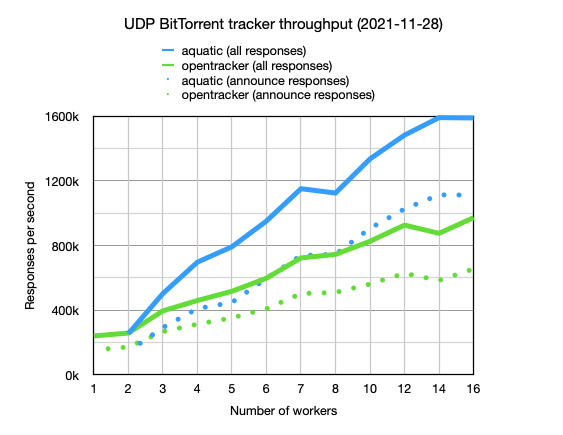
More details are available here.
Optimisation attempts that didn't work out
- Using glommio
- Using io-uring
- Using zerocopy + vectored sends for responses
- Using sendmmsg
aquatic_http: HTTP BitTorrent tracker
Implements:
- BEP 003: HTTP BitTorrent protocol (more details). Exceptions:
- Only runs over TLS
- Doesn't track the number of torrent downloads (0 is always sent)
- Only compact responses are supported
- BEP 023: Compact HTTP responses
- BEP 007: IPv6 support
- BEP 048: HTTP scrape support. Notes:
- Doesn't allow full scrapes, i.e. of all registered info hashes
IPv4 and IPv6 peers are tracked separately.
aquatic_http has not been tested as much as aquatic_udp but likely works
fine.
aquatic_ws: WebTorrent tracker
Aims for compatibility with WebTorrent clients. Notes:
- Only runs over TLS
- Doesn't track the number of torrent downloads (0 is always sent).
- Doesn't allow full scrapes, i.e. of all registered info hashes
IPv4 and IPv6 peers are tracked separately.
aquatic_ws has not been tested as much as aquatic_udp but likely works
fine.
Load testing
There are load test binaries for all protocols. They use a CLI structure similar to the trackers and support generation and loading of configuration files.
To run, first start the tracker that you want to test. Then run the corresponding load test binary:
./scripts/run-load-test-udp.sh
./scripts/run-load-test-http.sh
./scripts/run-load-test-ws.sh
To fairly compare HTTP performance to opentracker, set keep_alive to false in
aquatic_http settings.
Architectural overview

Copyright and license
Copyright (c) 2020-2022 Joakim Frostegård
Distributed under Apache 2.0 license (details in LICENSE file.)
Trivia
The tracker is called aquatic because it thrives under a torrent of bits ;-)